My Sunday reset routine for a smaller household with more moving parts: health, caregiving, travel, and a week that feels like mine.
I wrote about a Sunday reset years ago, back when it was built entirely around little kids — packed lunches, pool towels, permission slips, a fridge calendar color-coded for small boys. It worked, for that house, in that season.
That house doesn’t exist anymore. My sons are becoming the young men they’ll be. My week now holds fewer daily hand-offs and a lot more that’s future-facing: a parent’s medical visit to track from another continent, a financial review I book like I used to book pediatrician appointments, a gym session I no longer skip, a passport that needs renewing before the next trip. The reset stayed. Almost everything it’s resetting for has changed.
Here’s what it looks like now — and why I still do it every single week, no exceptions.
I want to be honest about something first: I almost let this habit go entirely a couple of years ago. There was a stretch when everything else in my life needed attention — my own health, a hard season with one of my sons, a move that meant starting over with people I hadn’t yet met.
A weekly Sunday ritual felt like the easiest thing to sacrifice when the bigger things were demanding so much.
What I found, eventually, was the opposite of what I expected. The harder the season, the more the reset mattered—not because it fixed anything, but because it was one hour a week when I got to decide what my life would look like, instead of simply reacting.

1
Step 1: Look Ahead at the Week
This part hasn’t moved. Sunday, coffee, calendar. What has moved is what I’m scanning for.
I’m still checking for the obvious — appointments, deadlines, which days are heavy and which have room to breathe. But I’m also looking further out than I used to. A season of parenting young kids asks you to manage the next 48 hours. This season asks something different: am I tracking the things that don’t announce themselves with urgency but matter more over time?
So my Sunday scan now includes:
- What does my own week of movement look like? Training days, a long walk, personal care like a haircut, and the appointments I keep putting at the bottom of the list
- Is there a call I owe my mother or my sister about something that needs following up?
- Which of my sons still needs a nudge this week, and for what — a form, a deadline, a ride he hasn’t arranged?
- Is there travel on the horizon that needs a document renewed, a booking confirmed, a bag half-packed early?
- Is there a financial or planning task sitting in the “someday” pile that actually has a date attached?
None of this is more complicated than the old list. It’s just aimed further down the road. That’s the real shift nobody warns you about — the mental load doesn’t shrink when the daily logistics do. It just changes shape, from constant and immediate to occasional and consequential. You trade a hundred small pings for a handful of things you genuinely cannot afford to drop.
2
Step 2: Meal Planning For Fewer People, More Intention
Cooking for a smaller table is its own kind of adjustment. I’m not solving for five plates or picky-eaters’ preferences anymore. I’m solving for a rhythm that fits fewer people, more travel, and a body that responds differently to what I eat than it did fifteen years ago.
What I do now:
- A quick inventory of the fridge and pantry before I plan anything, so nothing goes to waste.
- Two or three meals a week built around what I know supports how I want to feel — more protein, more vegetables, less of the reflexive processed food I used to lean on out of sheer exhaustion.
- Something simple on the nights I know I’ll be tired, and something I actually enjoy cooking on the nights I have the bandwidth.
- A grocery order placed early in the day, so it’s one less decision competing for my attention later.
I used to plan meals to survive a week. Now I plan them because how I eat is one of the few things fully in my control, and I’ve stopped treating that as a small thing.
It took me longer than I’d like to admit to make that shift. For years, meal planning was purely a logistics exercise — get something on the table, keep everyone fed, move on.
It wasn’t until I started paying closer attention to how differently my body responds to food now than it did in my thirties that the planning itself became a form of care rather than a chore.
I’m not chasing a particular number on a scale or following a strict protocol. I’m simply paying attention and building a week that reflects what I’ve learned about what actually makes me feel steady.
3
Step 3: Prep for What This Particular Week Needs
Every week still has its extras — the things that throw off an otherwise smooth run if you don’t see them coming. They’re just different extras now.
What I check for:
- Is my gym bag packed for the mornings I’ve committed to training — because a missing bag is still, embarrassingly, enough to talk myself out of going.
- Do I need anything specific for a trip that’s coming up, even a small one?
- Is there a document, form, or piece of paperwork I need to gather or send this week?
- Is there something one of my sons needs from me that I keep meaning to get to — a conversation, a signature, a ride to an appointment he can’t yet arrange on his own?
The details changed. The instinct didn’t. A weekly prep isn’t about doing more — it’s about not being ambushed by something you could have seen coming on Sunday with five quiet minutes and a cup of coffee.
4
Step 4: Check Who’s Carrying What
For years, this step meant syncing calendars with my husband around school and sports pickups and activities. It still means checking in — it just covers more ground now.
My youngest and I still compare calendars around the car we share, as always. But Sunday is also when my husband and I talk through the week ahead in fuller terms: who’s handling which piece of a trip we’re planning, who’s following up on which thread with the boys, whether either of us needs to shift something so the other can get to an appointment or a professional event.
None of this looks dramatic from the outside. It’s a handful of short conversations. But naming who’s carrying what, out loud, once a week, is still what keeps the whole thing from landing entirely on one person by accident.
5
Step 5: Reset the Spaces
This part is genuinely simpler than it used to be, and I don’t pretend otherwise. Less laundry. Fewer toys to find homes for. A quieter house most days.
What I still aim for every Sunday:
- Clear counters and an empty sink.
- A quick vacuum pass through the rooms used most.
- Surfaces that look like someone lives here with intention, not like someone is currently keeping it together by a thread.
- One space — usually the kitchen table and my desk — completely cleared, because a cluttered flat surface is the fastest way to make my whole house feel unfinished.
I don’t deep clean on Sundays, and I’ve stopped feeling like I should. The goal was never a spotless house. It was a home that meets you calmly on a Monday morning instead of adding one more thing to sort through before the week has even started.
Organizing Planners
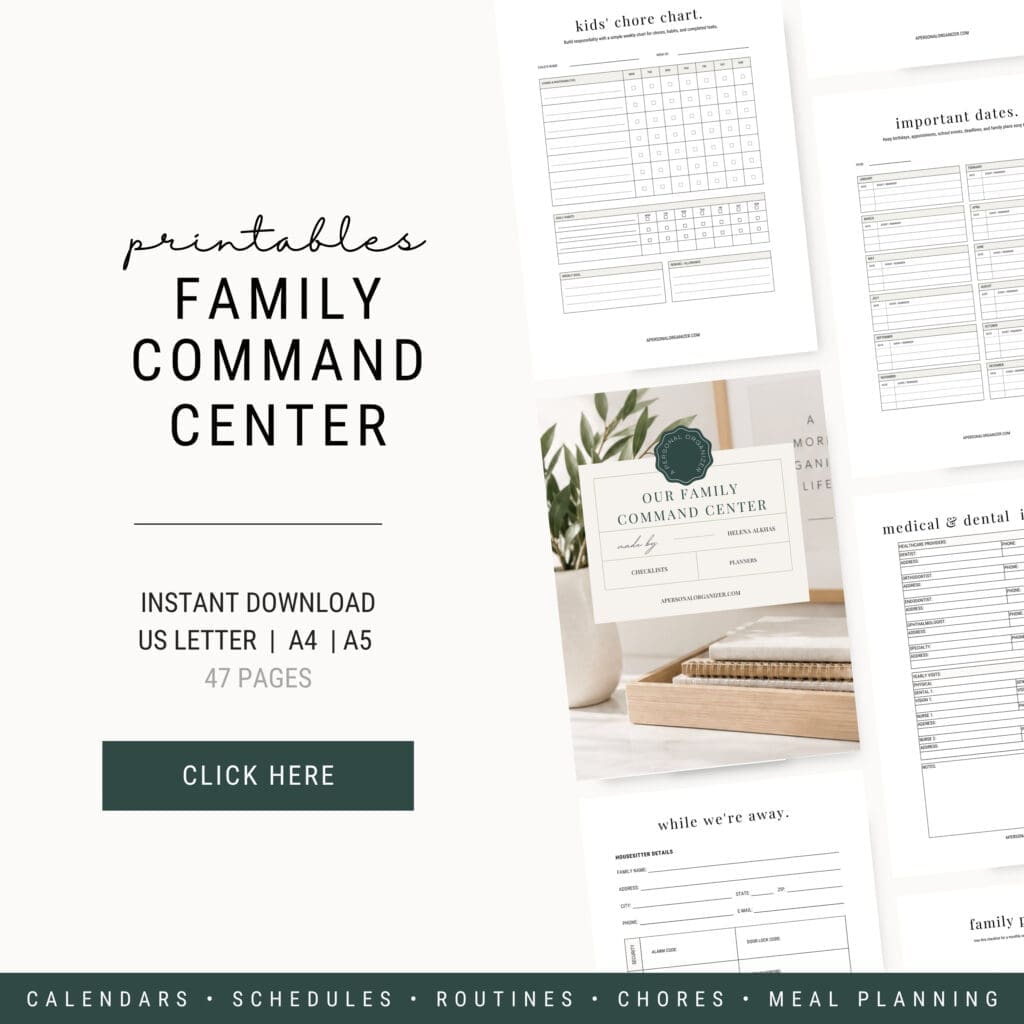
Organize Your Family
Give your family one central place to check schedules, routines, chores, and plans, helping everyone stay informed and involved.
6
Step 6: Reset the Mindset
This is the step I used to rush past, and the one I now protect most carefully.
A few minutes with tea or a candle, sitting with my planner, asking myself two honest questions: what actually went well last week, and what do I want more of in this one. Sometimes the answer is rest. Sometimes it’s connection, or movement, or simply fewer half-finished things hanging over me. I write it down, briefly, without turning it into a project.
What I’ve learned, slowly, is that this step does more work than any of the others. The calendar check, the meal plan, and the tidy counters make the week run. This is what makes the week feel like mine.
I spent a long stretch of years treating the mindset piece as optional — the first thing to cut when Sunday got busy. It took a wrecked nervous system to understand that skipping it never actually bought me time. It just meant I started the week already behind.
I don’t need a mindfulness deck or a particular ritual to make this step count, though I’ve tried a few over the years and learned they are more a distraction than a tool for me.
What matters more than the specific tool is the honesty of the questions. It’s easy to sit down with a planner and simply move tasks from one week to the next without ever asking whether the pace itself is sustainable.
This is the one part of my Sunday that isn’t about the week ahead at all — it’s about checking in with myself, the way I’d check in with anyone else I was responsible for taking care of.
7
Step 7: What Held Up, and What Didn’t
The reset itself held up. The reasons behind each step changed almost completely.
I’m no longer managing chaos for a house full of little ones. I’m holding the rhythm for a household with fewer hands and more moving parts — my own health, my parents’ care from a distance, a marriage and a family that has grown into a different shape than the one this routine was built for. The mental load didn’t disappear when the daily logistics did. It moved further out, onto a longer timeline, and it asks for a different kind of attention — steadier, less reactive, more deliberate.
Light the candle. Look at the calendar. Give yourself the time — you’re still worth building the week around.
More Home Organizing Tips
Tips and ideas to help you organize your home and life.